We are excited to share another Research Article Publication entitled;
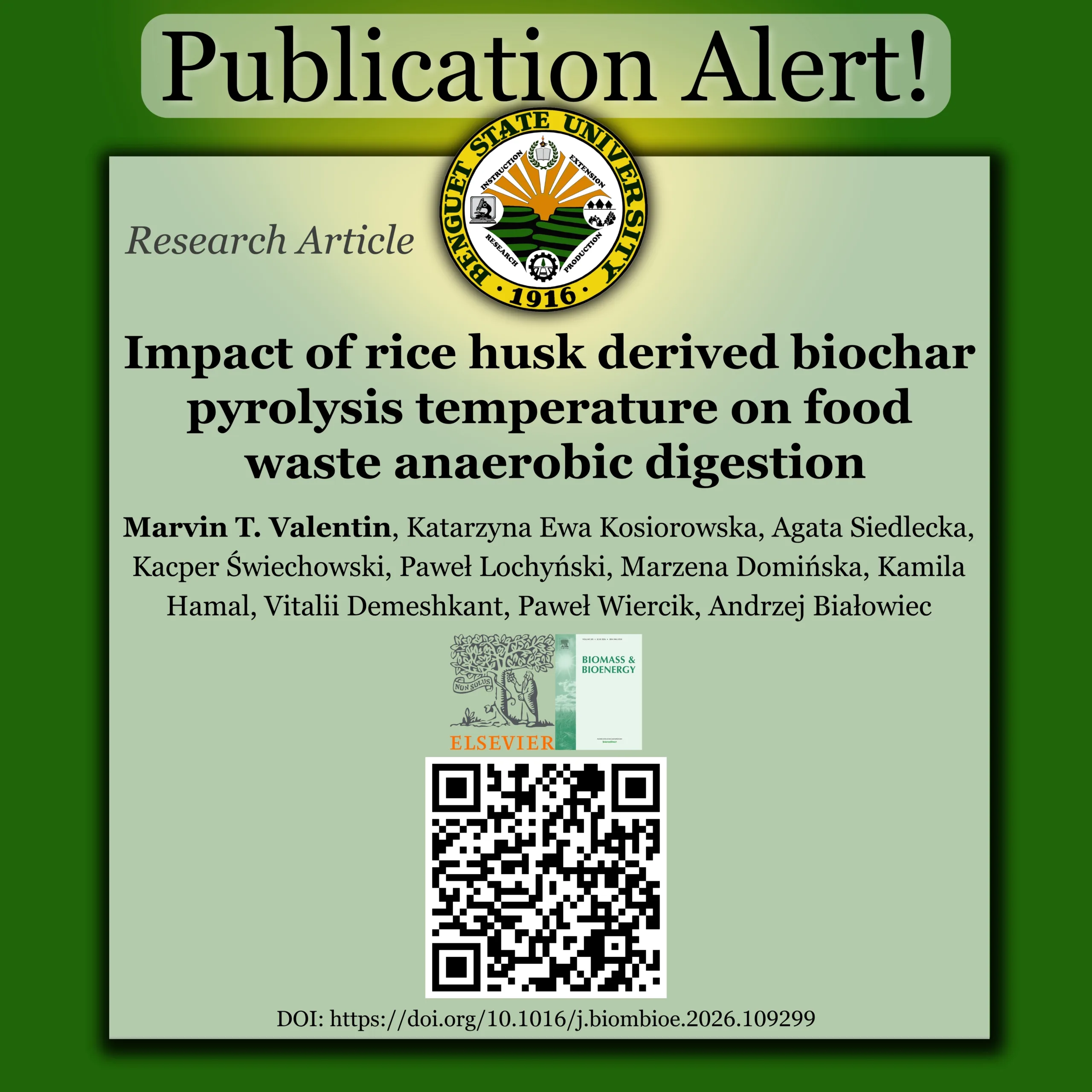
“Impact of rice husk derived biochar pyrolysis temperature on food waste anaerobic digestion”
by Marvin T. Valentin, Katarzyna Ewa Kosiorowska, Agata Siedlecka, Kacper Świechowski, Paweł Lochyński, Marzena Domińska, Kamila Hamal, Vitalii Demeshkant, Paweł Wiercik, Andrzej Białowiec
Mr. Marvin T. Valentin, is a faculty member from the BSU-College of Engineering and an assistant to the BSU Office of the Vice President for Academic Affairs
Abstract:
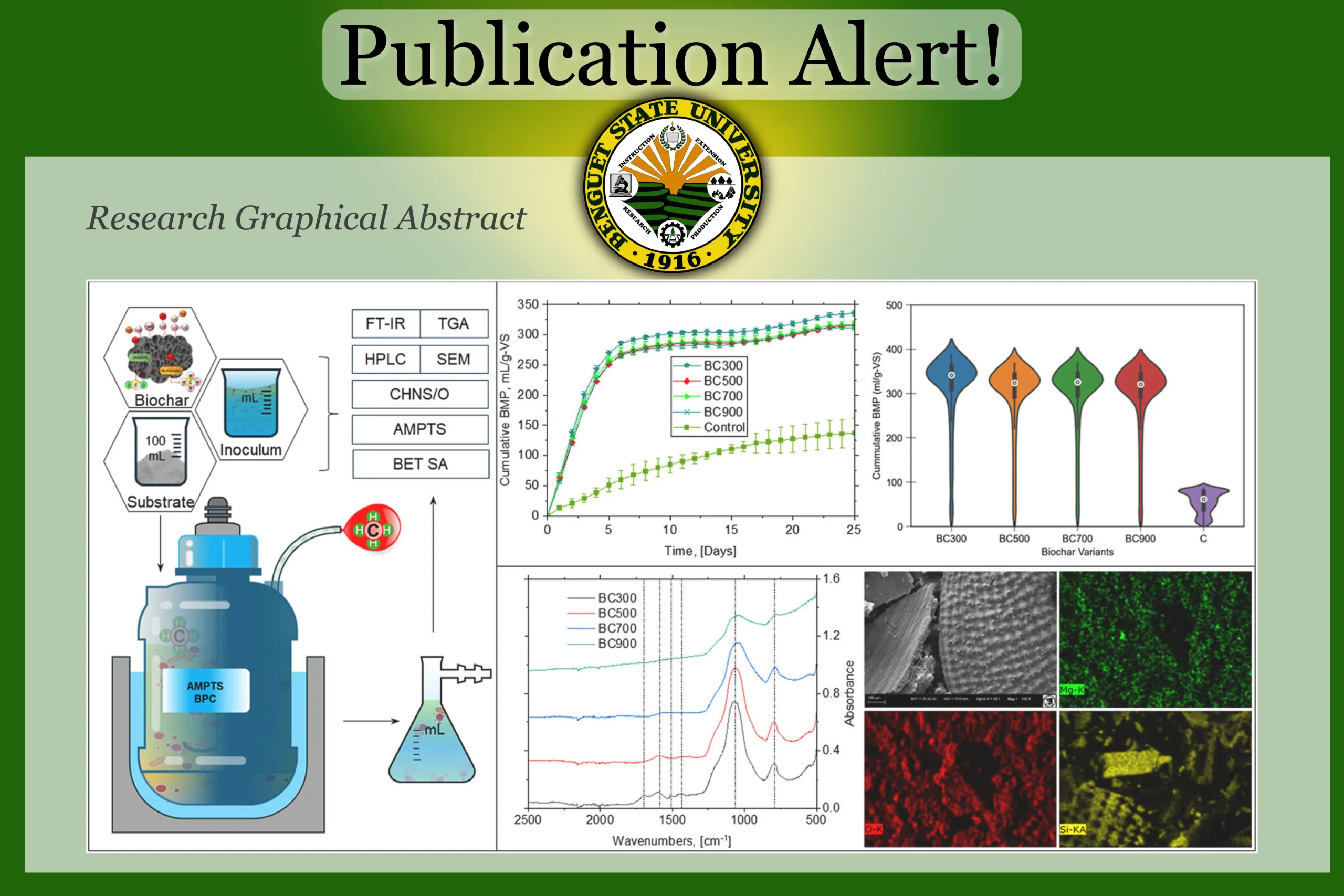
This study investigated the influence of rice husk biochar (RHBC) prepared at 300, 500, 700, and 900 °C (BC300, BC500, BC700, and BC900) on the anaerobic digestion (AD) of food waste. The properties of RHBC related to AD, including high heating value, specific surface, porosity, elemental mapping through scanning electron microscopy – energy dispersive X-ray spectroscopy (SEM-EDX), thermal decomposition, electrical conductivity (EC), elemental composition, functional groups, and mcrA gene copy numbers, were investigated. The specific surface area and mcrA gene copy numbers are listed as a property of the RHBC relating to AD. Parameters investigated during the AD process were biomethane potential, biomethane production rate, biodegradability, variation in the total volatile fatty acids, specific volatile fatty acids, pH, EC, and chemical oxygen demand, functional groups, changes in the nitrite, nitrate, ammonia, and nitrogen concentration. The study show that increase in the pyrolysis temperature (300 to 900 °C) resulted to the devolatilization and heteroatom removal in the RHBCs, resulting in decreased concentrations of H, N, and S, while the C content was relatively consistent across pyrolysis temperatures (38.09% to 39.62%). The reactors dopped with BC300 had the highest cumulative BMP at 335.76 mL/g-VS followed by BC500, BC700, and BC900 at 325.63, 316.76, and 311.36 mL/g-VS, respectively. These findings suggest that, compared to highly carbonized biochars made at higher temperatures, lower-temperature biochars, which retain more functional groups and labile components, offer better conditions for the production of biomethane.
This research was funded by the Wrocław University of Environmental and Life Sciences under the Innovative grant with Agreement No. N0N00000/0241/41/2023
We hope you will explore the key findings of this work and share or cite it to spread knowledge and insights to the wider academic community.
You can find the full publication here: https://www.sciencedirect.com/science/article/abs/pii/S0961953426003740?via%3Dihub
#BenguetStateUniversity, #PublicationAlert, #ResearchCorner