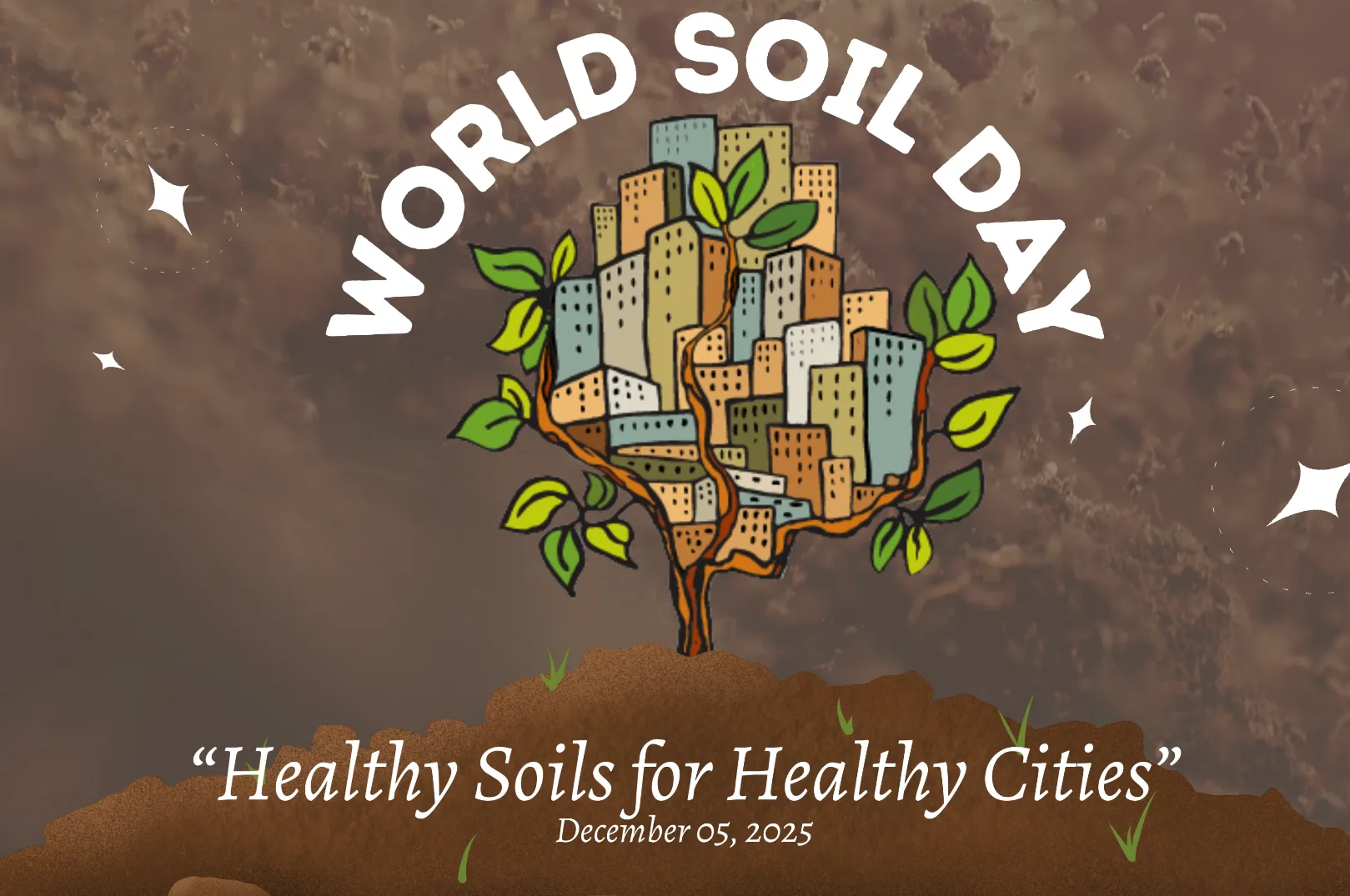
“Healthy Soils for Healthy Cities”
World Soil Day, celebrated every 5 December, reminds us of the importance of healthy soil and the need to manage soil resources in a sustainable way. The idea of having a day dedicated to soil began in 2002, when the International Union of Soil Sciences recommended it. With the support of the Kingdom of Thailand and the Global Soil Partnership, the FAO helped push for its formal recognition. In 2013, the FAO Conference approved it, and later that year, the UN General Assembly officially declared 5 December 2014 as the first World Soil Day.
Did you know?
Source: Food and Agriculture Organization of the United Nations (FAO)
• It can take up to 1,000 years to form just 2–3 cm of soil.
• 95% of our food comes from soil.
• 33% of soils worldwide are degraded.
• Soils supply 15 of the 18 naturally occurring chemical elements essential for plant growth.
• There are more living organisms in one tablespoon of soil than there are people on Earth.
• 2 billion people suffer from micronutrient deficiencies, also known as hidden hunger.
• Up to 58% more food can be produced through sustainable soil management.
• Soil is home to around 59% of Earth’s species.
• Agricultural production needs to increase by 60% by 2050 to meet global food demand.
Benguet State University joins this celebration as protecting our soil is also a key step in supporting global goals such as #SDG2 (Zero Hunger), #SDG12 (Responsible Consumption and Production), #SDG13 (Climate Action), and #SDG15 (Life on Land). Healthy soils help secure our food, protect biodiversity, and strengthen our resilience to climate change. As we celebrate World Soil Day, let us commit to using our land responsibly, supporting sustainable farming, and restoring degraded areas. Taking care of our soil today means securing a healthier and more sustainable future for everyone.